


Connecticut’s labor unions are making a third attempt to pass legislation that Gov. Ned Lamont has already vetoed twice.
S.B. 440 — An Act Concerning Unemployment for Striking Workers — would allow workers on strike to collect unemployment benefits after 14 days. Similar versions were vetoed in 2024 and 2025. Lawmakers are now sending the question back to the governor.
At issue is whether unemployment insurance, designed to assist workers who lose employment through no fault of their own, should be used to support voluntary work stoppages during labor disputes.
Supporters argue the bill would provide financial stability to workers exercising their right to strike. But testimony from union leaders suggests the policy’s purpose goes further.
The Leverage Argument
In public testimony, union representatives described how unemployment benefits could change the dynamics of collective bargaining.
Keri Hoehne, secretary-treasurer of UFCW Local 371, wrote in testimony about the 2019 Stop & Shop strike: “I deeply believe that if the employees had the backstop of unemployment benefits after two weeks, Stop & Shop would have thought differently about our contract and our negotiations, and the strike never would have happened.”
Jose Anaya, an organizer with UFCW Local 371 who participated in the strike, made a similar point in written testimony: “I believe that if we had the extra support of potentially collecting unemployment, our contract would have been settled without the loss of eleven days’ pay.”
Those statements illustrate a central concern: unemployment benefits would not merely cushion workers during a strike — they would increase leverage before and during negotiations.
That is a significant policy shift.
Unemployment insurance has historically functioned as a safety net during involuntary job loss. Extending it to cover voluntary strikes changes the program’s role in private labor disputes.
What Happens in Other States
Supporters often cite states such as New York and New Jersey, which allow striking workers to collect unemployment benefits after a waiting period.
A frequently cited example is the 2021 Buffalo healthcare strike. Those workers stayed on strike for 40 days — sustained in part by New York’s unemployment benefits. Supporters of S.B. 440 have repeatedly argued that few strikes last longer than two weeks, making the 14-day waiting period seem harmless. The Buffalo example — offered by supporters themselves — undermines that claim.
New York provides another example of how unions view these policies in practice. Earlier this year, nurses at hospitals in the Mount Sinai and NewYork-Presbyterian systems went on strike in what became one of the longest nurse walkouts in New York City history, lasting 41 days before ending in February 2026.
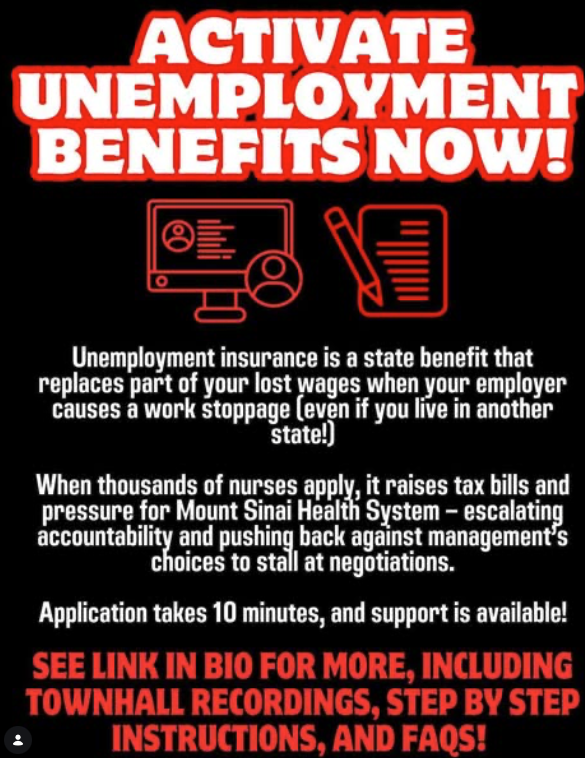
An Instagram post from Proud Union Nurses of Mount Sinai encouraged striking nurses to apply for unemployment insurance, explaining that when “thousands of nurses apply, it raises tax bills and pressure for Mount Sinai Health System — escalating accountability and pushing back against management’s choices to stall at negotiations.” In other words, the goal was not simply income replacement for workers. The strategy was to increase the employer’s costs during the strike itself.
Who Pays?
Unemployment insurance is primarily funded through employer payroll taxes. Under S.B. 440, employers involved in a strike — along with other businesses contributing to the system — would effectively help finance the work stoppage.
That shifts a portion of private labor dispute costs into a state-administered insurance program.
For businesses operating in an already high-cost state, any increase in unemployment claims can affect experience ratings and contribution rates. Those costs, in turn, are often incorporated into pricing, bids, and contracts.
In an economy where affordability is already strained, policymakers must consider those ripple effects.
Lamont’s Two Vetoes
Gov. Lamont vetoed similar proposals in 2024 and 2025, citing concerns about the unemployment trust fund and the traditional purpose of the program.
Labor leaders were furious. Connecticut AFL-CIO president Ed Hawthorne accused Lamont of siding with “mega-corporations and large defense contractors over working families.”
But Gov. Lamont’s instinct was correct — twice.
Whether one agrees with unions or management in specific disputes, the governor’s position has been consistent: unemployment insurance should not be used to finance strikes.
Now lawmakers are revisiting the issue.
A Third Decision
S.B. 440 presents a clear policy choice. Should Connecticut maintain the longstanding principle that unemployment insurance is reserved for involuntary job loss? Or should it redefine the program to support workers during voluntary strikes?
The bill is currently before the Labor and Public Employees Committee.
If it advances to the governor’s desk, he will once again face the same question.
And this time, it would be strike three.