

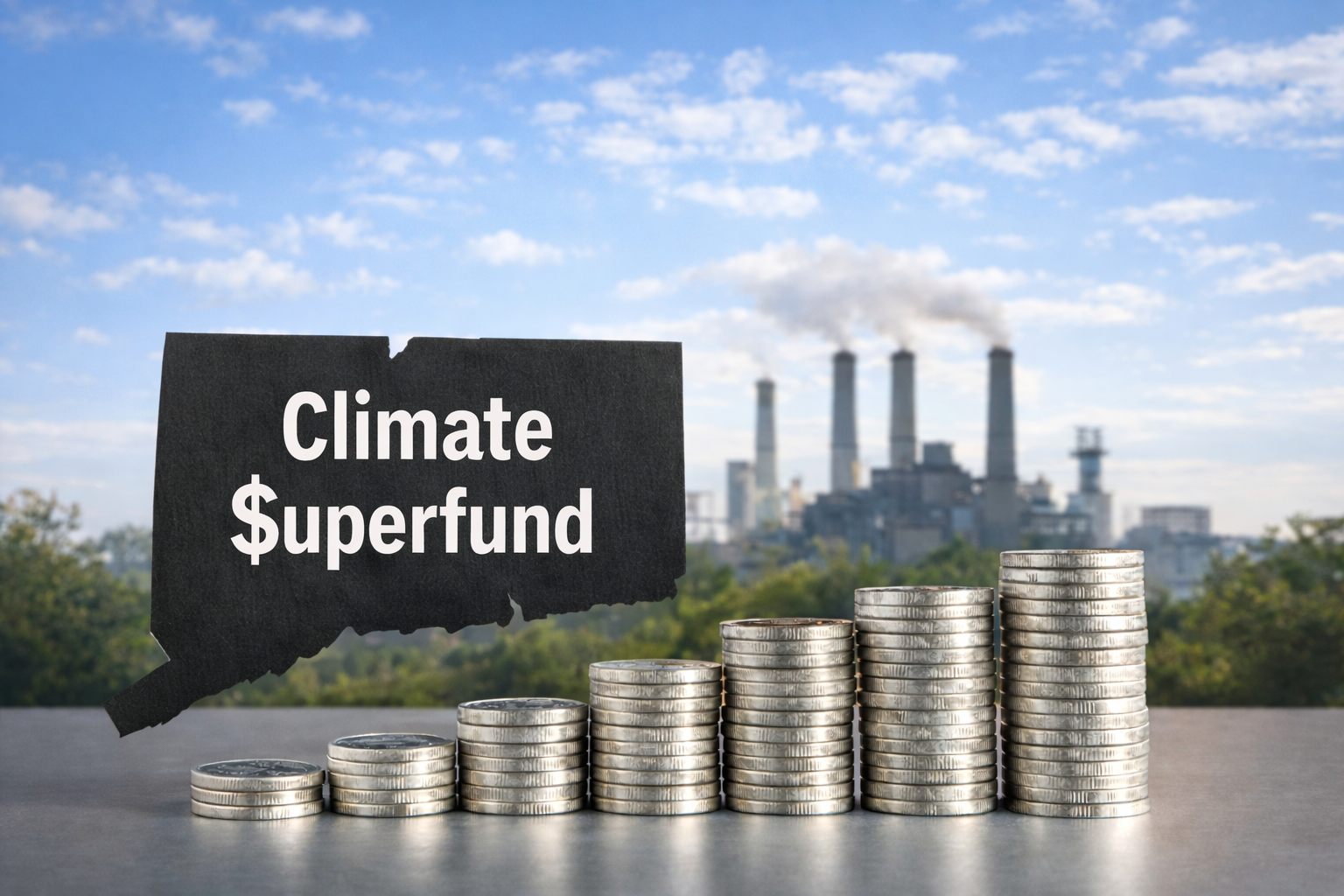
The Environment Committee will hold a public hearing on Feb. 20 regarding H.B. 5156, a proposal to create a new “climate superfund” requiring certain fossil-fuel companies to pay for climate-related projects across Connecticut — from infrastructure upgrades to flood mitigation and coastal protection.
While the bill’s stated goal is to help fund adaptation efforts tied to severe weather and environmental risks, it would also establish a significant new state-run cost-recovery program administered largely outside the traditional annual appropriations process.
Instead of lawmakers allocating funds year to year through the budget, payments collected from targeted companies would flow into a dedicated fund managed by the Department of Energy and Environmental Protection (DEEP), which would determine how the money is distributed.
That structure raises important questions about oversight, accountability, and long-term economic impact.
How the Program Would Operate
Under H.B. 5156, companies that extracted or refined fossil fuels and whose emissions exceed one billion metric tons between 1995 and 2024 could be designated as “responsible parties” and assigned a share of the state’s climate-related costs based on emissions data.
Liability would not depend on proof of wrongdoing; the measure specifies responsibility “regardless of fault.”
DEEP would be responsible for identifying covered companies, calculating decades of emissions, determining each company’s financial obligation, issuing payment demands, and administering the resulting funds.
Payments would generally be due within six months, though installment options could be permitted, with adjustments tied to inflation.
Once collected, the funds could be used for a wide range of climate adaptation purposes, including infrastructure upgrades, flood mitigation, public health initiatives, building retrofits, microgrids, and ecosystem restoration projects. At least 40 percent of expenditures would be required to benefit designated environmental justice communities.
While the bill targets major fossil-fuel producers, Connecticut remains reliant on these fuels, particularly during peak demand periods. As a result, any significant financial burden imposed on energy producers could have broader economic implications beyond the companies directly assessed.
Legal Uncertainty
Connecticut would not be the first state to pursue this approach. Vermont and New York have enacted similar climate superfund laws and are currently defending them in federal court.
Legal challenges argue that federal environmental statutes — particularly the Clean Air Act — may preempt state-level efforts to impose additional liability for greenhouse gas emissions. Plaintiffs also contend that retroactively assigning costs for decades-old lawful conduct and applying liability to out-of-state activities raise constitutional concerns.
The outcome of those cases could determine whether such programs withstand judicial scrutiny or are ultimately invalidated after extended litigation.
Even if courts uphold the framework, prolonged legal battles may delay implementation and create additional uncertainty for the energy sector.
Cost and Economic Implications
Although the bill directs payments toward large fossil-fuel companies, energy markets do not operate in isolation. Connecticut relies on regional wholesale electricity markets, and new cost structures imposed upstream can affect supply planning, pricing, and long-term investment decisions.
Energy costs influence nearly every sector of the economy — from heating and electricity to transportation, food production, and manufacturing. Policies that significantly alter how energy is financed or regulated often extend beyond their intended targets.
Retroactive liability covering nearly three decades may also introduce uncertainty for companies evaluating long-term infrastructure investments in the region.
That does not mean the bill will necessarily produce sharp price increases. It does mean the economic effects are complex and difficult to isolate in advance.
Oversight and Governance Questions
Beyond the economic implications, H.B. 5156 would centralize substantial authority within a single executive branch agency.
DEEP would determine liability calculations, oversee collections, and direct spending decisions with limited ongoing legislative involvement once the program is established.
The legislature would authorize the framework, but the day-to-day administration and allocation decisions would largely reside with regulators.
Supporters argue this structure allows for technical expertise and streamlined implementation. Critics raise questions about transparency, legislative oversight, and how such a significant funding mechanism should be monitored over time.
A Policy Choice With Long-Term Consequences
Connecticut faces real environmental challenges — including flooding, coastal erosion, aging infrastructure, and the increasing cost of extreme weather. Funding adaptation efforts will require substantial resources.
H.B. 5156 represents one approach to generating those funds. It also represents a significant shift in how liability, oversight, and energy-related costs are structured in the state.
The February 20 hearing offers an opportunity for lawmakers and residents to examine not only the goals of the proposal, but also its long-term fiscal, legal, and economic implications.
Whether or not the bill ultimately advances, the questions it raises — about accountability, cost transparency, and the role of state agencies in administering large off-budget programs — are likely to remain part of Connecticut’s broader energy and climate debate.