

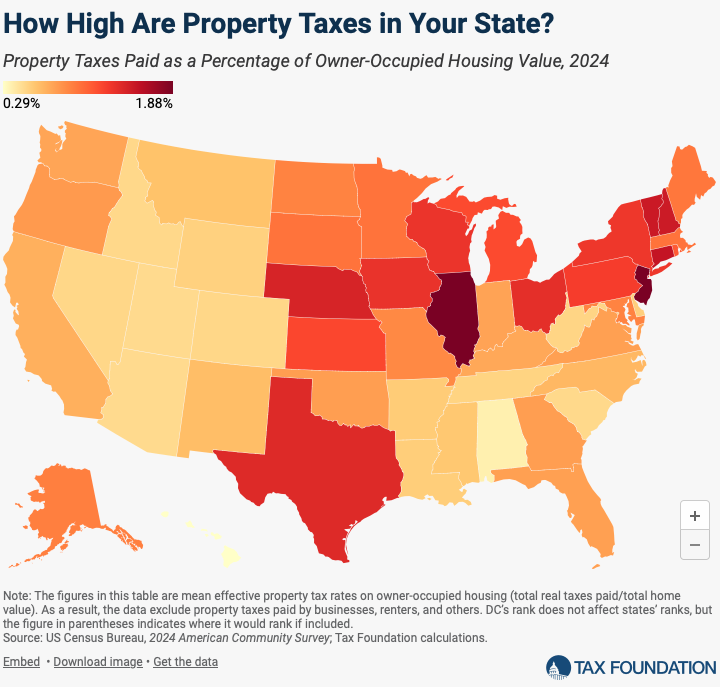
Connecticut homeowners continue to face some of the highest property taxes in the country, and that’s not changing anytime soon.
A new report from the Tax Foundation, using the latest U.S. Census Bureau’s data, ranks Connecticut with the third-highest effective property tax rate in the nation for the third consecutive year.
This isn’t a temporary spike. It’s a pattern.
Just a few years ago, Connecticut ranked fifth. Now it has moved into — and remained in — the top tier, trailing only New Jersey and Illinois.
New England is Expensive — But Connecticut Stands Out
Property taxes tend to run higher across New England, but Connecticut consistently sits near the top.
Among neighboring states:
- Connecticut: 3
- Vermont: 4
- New Hampshire: 5
- Rhode Island: 15
- Massachusetts: 16
- Maine: 19
The region is expensive, but Connecticut remains one of its most costly outliers.
Higher than New York
Even compared to New York, often seen as a high-tax benchmark in the Northeast, Connecticut comes out higher.
New York ranks 11th nationally, with an effective property tax rate of 1.30 percent, while Connecticut stands at roughly 1.54 percent.
That gap may sound small, but on higher-value homes, it translates into thousands of dollars more each year.
A National Divide
The three states with the highest effective property tax rates are:
- New Jersey
- Illinois
- Connecticut
At the other end of the spectrum, the lowest-tax states include:
50. Hawaii
49. Alabama
48. Utah
The difference between those groups is significant. Homeowners in high-tax states pay a much larger share of their home’s value annually.
Why Connecticut Stays Near the Top
Property taxes are primarily local, funding schools, public safety, and infrastructure. In Connecticut, they are the primary revenue source for municipalities.
At the same time, local officials have limited options to raise revenue beyond the property tax. Unlike the state, municipalities do not levy broad-based income or sales taxes, leaving property taxes as the primary tool to cover rising costs.
State-level decisions also play a role. When state aid to municipalities does not keep pace with expenses, particularly in areas like education, local governments often turn to property taxes to close budget gaps.
As a result, the combination of high local spending needs, limited revenue options, and reliance on property taxes has contributed to Connecticut’s persistently high ranking.
Temporary Relief, Structural Problem
Lawmakers are aware of the issue. Recent proposals would send additional aid to municipalities to help offset local costs.
House Democrats recently proposed sending between $100 million and $150 million in additional aid to municipalities to help school districts avoid steep tax hikes.
“When you don’t give municipalities the support they need… their only way to raise revenue is to raise the property tax,” House Speaker Matt Ritter said.
The challenge is that many of these proposals rely on one-time funds, not long-term solutions, meaning the pressure is likely to return.
A Pattern, Not a Fluke
What stands out most is not just Connecticut’s ranking — it’s the consistency.
Three straight years in the top three, combined with a climb from fifth place just a few years ago, signals a structural issue rather than a temporary condition.
For homeowners, that means persistently high carrying costs. For prospective buyers, it raises the barrier to entry.
And for the state as a whole, it reinforces a broader affordability challenge that continues to shape decisions about where to live, work, and invest.
At this point, Connecticut’s ranking is no longer surprising.
It’s expected.