

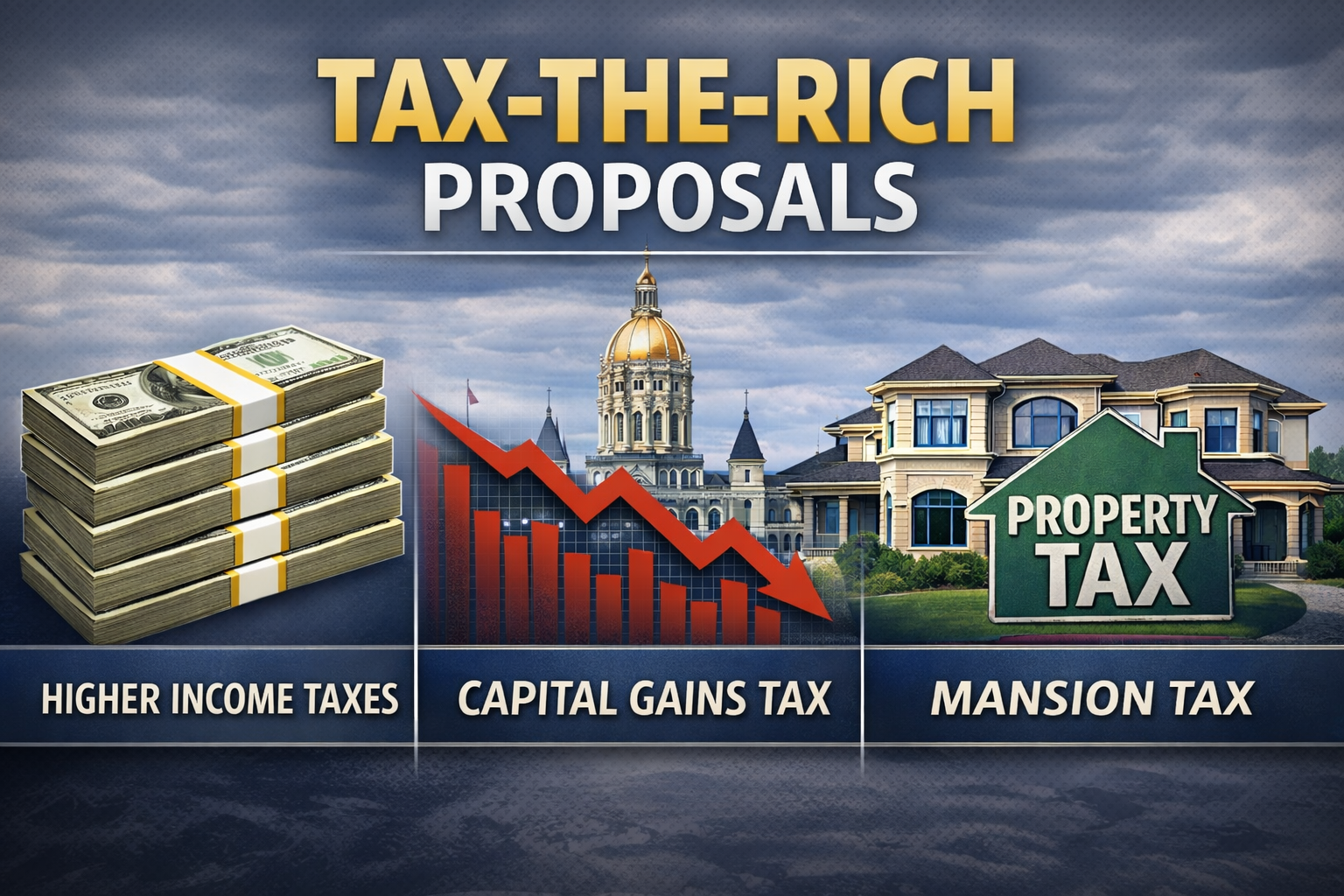
Connecticut lawmakers are set to consider three tax proposals at a Feb. 27 public hearing that would increase income taxes, impose a capital gains surcharge, and create a statewide property tax on high-value homes.
The measures, all before the Finance, Revenue and Bonding Committee, would raise taxes on high earners and expensive real estate and represent one of the most significant changes to state taxation in recent years.
Supporters argue the proposals would shift more of the burden onto households with greater resources. Critics warn they could affect economic competitiveness, investment behavior, and long-term revenue stability.
Similar policies adopted elsewhere have generated revenue but also sparked lawsuits, ballot fights, and extended policy disputes, with mixed evidence on their long-term fiscal and economic impacts.
Top Income Tax Rate Hike
House Bill 5133 would increase Connecticut’s highest marginal income tax rate from 6.99 percent to 7.99 percent. The higher rate would apply to income in the top tax bracket under the state’s graduated income tax structure.
Although Connecticut’s overall tax system is often described as regressive due to its heavy reliance on property taxes, its income tax is structured progressively. As a result, a relatively small share of high-income households generate a disproportionate share of income tax revenue. That concentration makes state collections sensitive to economic conditions, investment income, and migration trends affecting those taxpayers.
Experience in other states highlights the complexity of that reliance. In California, Gov. Gavin Newsom has cautioned that heavy dependence on high-income earners can produce volatility. He warned that proposals targeting the wealthiest residents may generate short-term revenue but could reduce longer-term collections if those taxpayers relocate or adjust behavior.
Capital Gains Surcharge
Senate Bill 104 would impose a surcharge on capital gains for taxpayers in the top income brackets. The proposal would apply an additional 1 percent tax to gains for those in the second-highest bracket and 1.75 percent for those in the top bracket.
Capital gains revenue is among the most volatile components of state tax collections. It tends to surge during strong financial markets and decline sharply during downturns.
Higher taxes on capital gains can also influence behavior. Financial advisers note that investors may delay selling assets when tax rates rise, a phenomenon economists refer to as the “lock-in effect.” Because capital gains taxes are triggered only when gains are realized, fewer transactions can mean less taxable income overall. In some cases, that dynamic has limited the long-term revenue effect of higher rates.
A New Statewide Property Tax
Perhaps the most controversial proposal is Senate Bill 101, which would establish a state-level property tax on high-value residential real estate — something Connecticut has not previously imposed.
Under the bill, homes assessed above $3 million would be subject to a tax ranging from 2 to 4 mills depending on value.
Property taxes in Connecticut are set by local municipalities, not the state. Creating a statewide property tax would represent a significant structural shift.
In Connecticut law, “residential real property” commonly refers to one- to four-family housing — not only large estates — meaning duplexes, triplexes, and certain multifamily properties could fall within the definition depending on assessed value.
In other states and cities, so called “mansion taxes” sometimes produced broader effects than initially anticipated. In Los Angeles, a tax on high-value property transactions was followed by sharp declines in housing construction permits across price ranges, including affordable units. Researchers found some developers shifted projects outside city limits or adjusted designs to avoid tax thresholds.
Owners of rental housing typically pass tax increases through to tenants over time, meaning a levy aimed at high-value property could translate into higher rents. In Chicago, a proposed transfer tax increase on high-value property drew criticism that apartment buildings, small businesses, and renters, not just wealthy homeowners, would bear much of the burden.
A statewide property tax framed as a “mansion tax” could therefore have broader implications for housing supply and affordability.
A Different Question
The debate over these proposals centers on fairness and affordability. Connecticut’s tax structure places significant pressure on working households, particularly through high housing costs and local property taxes.
At the same time, some existing forms of financial assistance go unclaimed.
According to the United Way of Connecticut and SimplyCT, roughly 45,000 low-income families failed to claim an estimated $120 million in federal tax benefits in a recent year. Thousands of eligible residents do not claim the Earned Income Tax Credit or fail to claim the full amount, leaving millions of dollars uncollected annually.
Free tax preparation programs have helped return tens of millions of dollars to households, with refunds typically spent on essentials such as rent, utilities, childcare, and food — money that circulates directly back into local communities.
Lawmakers seeking to improve affordability could consider expanding awareness and access to existing credits while evaluating the potential long-term effects of sweeping changes to the state’s tax structure.
As the hearing approaches, the central question remains not simply who pays more, but how Connecticut balances revenue needs, economic competitiveness, and affordability in a state already navigating high costs and fiscal constraints.